
How Revolutionizing AI Healthcare in 2025

AI Healthcare Is Changing the Game: How Doctors Are Teaming Up With Algorithms to Diagnose Faster and Smarter
Hey Xplorianz, gather up for a rhyme as we dive into AI time, where AI Healthcare climbs and doctors drop their grind while tech keeps things aligned, yeah, it’s nerdy, but still kinda prime. Like mixing nasi goreng with rocket fuel, weird combo but somehow cool.
AI Healthcare Goes Mainstream: From Sci-Fi Buzz to Hospital Reality
The medical world in New Orleans is living the AI wave for real, not just the “Hollywood robot with glowing eyes” hype. Doctors like Dr. David Smith at LSU Health and Dr. Alex Attia at Tulane are straight-up using AI to spot lung nodules, analyze CT scans, and rebuild tricky tumors into 3D models. It’s not a maybe, it’s happening daily, saving minutes and reducing human mistakes. Think of AI like a turbo-charged assistant who never gets tired and doesn’t need coffee refills.

Meanwhile, the American Medical Association (AMA) reported that 66% of U.S. physicians used AI in 2024, compared to just 38% in 2023, a wild jump. Source: American Medical Association (AMA)
That jump alone shows AI isn’t a fad. It’s sticking around harder than that one friend who never leaves the group chat.
How AI Healthcare Boosts Radiology: Faster Scans, Earlier Detection, Fewer Misses
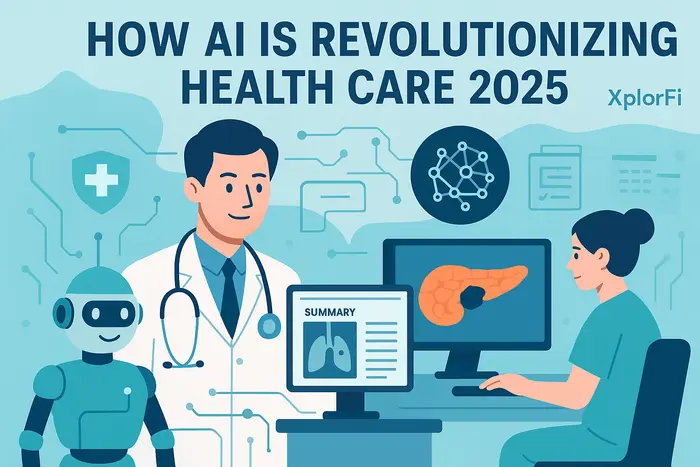
In radiology, AI Healthcare is basically the MVP. Dr. Smith gets auto-generated AI summaries pointing out lung nodules, measuring their size, showing if they’ve changed, and flagging suspicious abnormalities. That’s huge, especially for diseases like lung cancer, which rely heavily on early detection. It’s like having a digital Sherlock Holmes analyzing every pixel of a scan without getting distracted by lunch plans.
At Tulane, Dr. Attia is working on reconstructing pancreatic tumors into 3D models so docs can see the shape, size, and danger from all angles. Pancreatic cancer is notoriously hard to detect early, so this is a major game-changer. Like turning a flat treasure map into a full 3D video game world where the treasure (or tumor) can’t hide behind the trees.
AI Healthcare Isn’t Just About Diagnoses — It’s Fixing Doctor Burnout Too
One of the biggest silent killers in healthcare isn’t a disease, it’s paperwork. Doctors spend HOURS writing notes, summarizing patient histories, typing visit reports, and handling billing codes. But AI tools, especially new generative-AI medical scribes, cut that time drastically.
A peer-reviewed study in 2024 found that generative AI reduced doctor documentation time by up to 44%. Source: Arxiv
When AI handles the boring parts, doctors spend more time doing what actually matters, talking to patients, thinking critically, and making decisions. It’s like letting someone else chop onions while you focus on actually cooking the dish.
READ MORE:
AI Web3 Projects: Best When Smart Meets Decentralized
Discover the Magic of Web3 Decentralized Innovation
AI Healthcare Still Has Flaws: Bias, Bad Data, and Those Weird “Hallucinations”
As cool as AI is, it still messes up. Both Dr. Smith and Dr. Attia agree: AI is only as good as the data it’s trained on. If the training data is biased — meaning skewed toward certain ages, skin tones, or patient groups — the AI might misdiagnose other populations.
This isn’t a small issue either. A 2025 analysis found that some AI diagnostic models showed reduced accuracy in minority populations due to poor training data representation.
AI errors aren’t just math mistakes, sometimes the model literally makes stuff up (the famous “hallucination”). That’s why doctors still double-check outputs. AI may be fast, but it has the same overconfidence as your cousin who insists he’s a crypto expert because he bought DOGE once.
AI Healthcare Must Follow Rules — FDA Approval, HIPAA, and Zero Patient Data Leakage
Every AI tool used in U.S. medical centers must follow strict rules. Dr. Smith notes that no AI model touches real patient care unless approved by the FDA. Meanwhile, Dr. Attia reminds the world that HIPAA doesn’t play games, patient data can’t be shared, uploaded, or fed into AI models without strict protections.
This means hospitals can’t just download random “AI medical tools” from GitHub and plug them into patient systems. Healthcare AI is guarded tighter than your Wi-Fi password when the neighbor keeps asking for it.
Will AI Healthcare Replace Doctors? Spoiler: Nah, Not Even Close
Despite the hype, the docs are unanimous: AI isn’t replacing humans anytime soon. Not in 5 years, not in 10. Maybe in 100, who knows, but for now, AI lacks emotional intelligence, moral reasoning, and full-context understanding.
Dr. Smith even laughs at the early predictions claiming radiologists would be obsolete by 2025. Instead, radiology became the field using AI the MOST, yet still relies heavily on human judgment.
AI is a tool, not a takeover. Like a calculator helping you solve math, but not doing the exam for you.
The Future of AI Healthcare: Faster, Smarter, More Fair — If We Build It Right
AI Healthcare can:
- catch diseases earlier
- help doctors handle more patients
- cut diagnosis time
- reduce errors
- lower burnout
- improve global medical access
But only if the tech is trained responsibly, tested properly, and monitored constantly. Otherwise, the future will look like a GPS that confidently tells you to “turn left into the ocean.”
READ MORE:
Revolutionary AI Crypto Tools to Dominate 2025’s Bull Run
https://www.xplorfi.com/revolutionary-ai-crypto-tools-2025/
AI Tools Transform Education 2025
https://www.xplorfi.com/ai-tools-transform-education-schools-battle/
Final Thoughts: AI Healthcare Is the Sidekick Humanity Didn’t Know It Needed
At the end of the day, AI isn’t here to replace humans, it’s here to upgrade them. It makes doctors faster, safer, sharper, and more efficient. But human judgment, compassion, and intuition still lead the way.
Just think of AI like a superhero sidekick, fast, clever, and great at details, but the human doctor is still Batman behind the wheel, calling the shots and saving the day.
Yo Xplorianz, Got spicy takes or want us to dig into your favorite project? Slide into our inbox Facebook, or tag us on X . Stay sharp, stay weird, and keep Xploring.
Disclaimer:
This article is for informational and entertainment purposes only and does not constitute financial advice. Always do your own research (DYOR) before making any investment decisions, your money, your call. Crypto’s wild, so stay sharp out there!







Tidak ada komentar